27 Jan

EYES ON DIABETES

EYES ON DIABETES

ACT TODAY TO CHANGE TOMORROW – Uduak Ukpediabetes
Over the years, I have had so many first hand experiences with people living with diabetes, and the adverse effects have been so devastating.  I have an aunt that has lost her sight and needs to be led around – losing her independence, a close family friend that has had her lower limbs amputated and gets by in a wheel chair – also losing her independence, people with countless sores that refuse to heal, untimely deaths  and I could go on and on and on.

These people once lived normal lives like you and I and then everything changed….

The question is posed - What do these people have in common?  The answer, like a slap in the face is “DIABETES MELLITUS”, a major cause of untimely deaths in our society today.

What is diabetes mellitus?

Diabetes mellitus (commonly referred to as diabetes) is a disease of the pancreas, an organ behind your stomach that produces the hormone insulin. Insulin helps the body use food for energy. When a person has diabetes, the pancreas either cannot produce enough insulin, uses the insulin incorrectly, or both. Insulin works together with glucose (sugar) in the bloodstream to help it enter the body's cells to be burned for energy. If the insulin isn't functioning properly, glucose cannot enter the cells. This causes glucose levels in the blood to rise, creating a condition of high blood sugar or diabetes, thereby leaving the cells without fuel.

What are the common types of diabetes?

There are two common forms of diabetes: type 1 and type 2.

Type 1: Type 1 diabetes occurs because the insulin-producing cells of the pancreas (beta cells) are damaged. In type 1 diabetes, the pancreas makes little or no insulin, so sugar cannot get into the body's cells for use as energy. People with type 1 diabetes must use insulin injections to control their blood glucose. Type 1 is the most common form of diabetes in people under age 20-30, but it can occur at any age. Ten percent of people with diabetes are diagnosed with type 1.

Type 2: In type 2 diabetes, the pancreas makes insulin, but it either doesn't produce enough insulin or the insulin does not work properly. Type 2 diabetes may sometimes be controlled with a combination of diet, weight management and exercise. However, treatment also may include oral glucose-lowering medications or insulin injections.

Generally, type 2 diabetes is more common in people over age 40 who are overweight. Nine out of 10 people with diabetes have type 2.

What causes diabetes?

Health care providers do not yet know what causes diabetes. The following factors may increase your chance of getting diabetes:

  • Family history of diabetes or inherited tendency
  • Being overweight (20 percent or more over your desired body weight)
  • Physical stress (such as surgery or illness)
  • Use of certain medications, including steroid and blood pressure medications
  • Injury to pancreas (such as infection, tumor, surgery or accident)
  • Autoimmune disease
  • High blood pressure
  • Abnormal blood cholesterolor triglyceride levels
  • Age (risk increases with age)
  • Alcohol (risk increases with years of heavy alcohol use)
  • Smoking
  • Pregnancy

It is important to note that sugar itself does not cause diabetes. Eating a lot of sugar can lead to tooth decay, but it does not cause diabetes.

How is diabetes diagnosed?
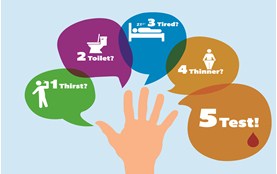
dia1The preferred method of diagnosing diabetes is the fasting plasma glucose test (FPG). The FPG measures your blood glucose level after you have fasted (not eaten anything) for 10 to 12 hours.

Normal fasting blood glucose is between 70 and 100 mg/dl for people who do not have diabetes. The standard diagnosis of diabetes is made when:

  • A patient has a fasting blood glucose level of 126 mg/dl or higher on two separate occasions; or
  • A patient has a random blood glucose level of 200 mg/dl or greater and has common symptoms of diabetes, such as:
  • Increased thirst
  • Frequent urination
  • Increased hunger
  • Fatigue
  • Blurred vision
  • Weight loss

On occasion, an oral glucose tolerance test may aid in the diagnosis of diabetes or an earlier abnormality that may become diabetes - called impaired glucose tolerance.

Another test, the A1C test, measures your average percentage of glycated hemoglobin, or HbA1c, in the blood. This test tells you about your blood glucose control for the past 2 to 3 months. It gives you an idea of how your treatment plan is coming along but does not replace daily testing.

Other symptoms of diabetes may include:

What are some of the long-term complications of diabetes?

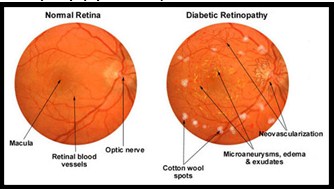
Retinopathy (eye disease):

All patients with diabetes should see an ophthalmologist (eye specialist) yearly for a dilated eye examination. Patients with known eye disease, symptoms of blurred vision in one eye or who have blind spots may need to see their ophthalmologist more frequently.
dia2

Nephropathy (kidney disease):

Urine testing should be performed yearly. Regular blood pressure checks also are important because control of high blood pressure is essential in slowing kidney disease. Generally, blood pressure should be maintained less than 130/80 in adults. Persistent leg or feet swelling also may be a symptom of kidney disease and should be reported to your doctor.

Neuropathy (nerve disease):
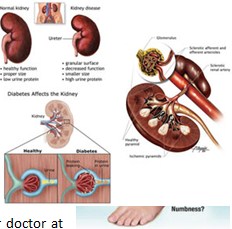
 dia3Numbness or tingling in your feet should be reported to your doctor at your regular visits. You should check your feet daily for redness, calluses, cracks or breakdown in skin tissue. If you notice these symptoms before scheduled visits, notify your doctor immediately.

Other long-term may complications include:

  • Eye Problems including glaucoma and cataracts
  • Dental problems
  • High blood pressure
  • Heart disease


How is diabetes managed?

There is no cure for diabetes, but it can be treated and controlled. The goals of managing diabetes are to:

  1. Keep your blood glucose levels as near to normal as possible by balancing food intake with medication and activity.
  2. Maintain your blood cholesterol and triglyceride (lipid) levels as near the normal ranges as possible by decreasing the total amount of fat to 30% or less of your total daily calories and by reducing saturated fat and cholesterol.
  3. Control your blood pressure. (Your blood pressure should not go over 130/80.)
  4. Decrease or possibly prevent the development of diabetes-related health problems.


You hold the keys to managing your diabetes by:

  • Planning what you eat and following a balanced meal plan
  • Exercising regularly
  • Taking medication, if prescribed, and closely following the guidelines on how and when to take it
  • Monitoring your blood glucose and blood pressure levels at home
  • Keeping your appointments with your health care providers and having laboratory tests completed as ordered by your doctor.

What you do at home every day affects your blood glucose more than what your doctor can do every few months during your check-ups.

What is gestational diabetes?

Gestational diabetes occurs when there is a high blood glucose level during pregnancy. As pregnancy progresses, the developing baby has an increased need for glucose. Hormone changes during pregnancy also affect the action of insulin, resulting in high blood glucose levels.

Pregnant women who have an increased risk of developing gestational diabetes include those who:

  • Are over 25 years old
  • Are above their desired body weight
  • Have a family history of diabetes

Usually, blood glucose levels return to normal after childbirth. However, women who have had gestational diabetes have an increased risk of developing type 2 diabetes later in life.
dia4

27 Jan

VIRTUES THAT MAKES FOR SUCCESS

VIRTUES THAT MAKES FOR SUCCESS

ORDER

-Josiah Diaso

I think it is important that I begin this write up by defining success away from the widely held belief that success is the apparent abundance of possession and/or prestige. Don’t get me wrong, material abundance can be a measure of success if one sets it as a goal, but it must not be mistaken to be success in itself. Success in the context of this write-up is defined as attainment of set goals.

I believe strongly that all of life is built upon definite principles, and that the consistent application of these principles will always lead to remarkable results.

Let me expound on this a little…

In physical science, we learn that nature achieves its end of regeneration and propagation by the continuous working of natural principles. There is in nature the principle of cause and effect, which according to many is one of the most profound natural principle upon which is hinged the very essence of things. Newton describes it thus, “For every action there is an equal and opposite reaction”. Implying that you get only to the extent that you give. For example, the beauty of rainfall is achieved by an interplay between evaporation, transpiration and condensation, which individually are effects of causes and in other scales, causes of effects that eventually culminates in rainfall. The variability of rainfall in different regions of the world with differing conditions that affect the working of these principles are telltale.

The point of the foregoing explanation is that all of nature adheres to definite principles for goal attainment; and we too as humans (Natural entities) must adhere to natural principles to reach our ultimate desires. For this write-up, we may want to consider principles in terms of virtues; virtues that when one possesses is almost guaranteed to result to success.

THE VIRTUE OF “ORDER”

Order has been defined as the planning of time and organizing of resources. Some writers have hypothesized that order is the first principle of things. According to them, order precedes everything else; fact of which is agreed on by both creationists and evolutionists. According to the creationists, before the creative process began, it was imperative for the creator (God) to impose order on things: He separated night from day, he divided the dry land and the sea before he brought anything to be, as a matter of fact, things were brought about by the order that God put in place; trees began to grow and nature flourished because processes were instituted. The evolutionists have it that from a chaotic universe, a big bang occurred that set things in their ordered places necessitating life to evolve.

Similarly For the human individual and organizations, what precedes any level of success is order. Nothing meaningful has ever been attained in disarray. According to Lawyer and Author Sydney Newton Bremmer; “The methodical man by an orderly arrangement of his work conserves the energy of body and mind that is often frittered away and without adequate returns by the unmethodical man”. Bremmer in this quote asserts that orderly arrangement of work amounts to far better results than an unorganized work. As the definition of order entails, there is a need for proper planning and procedures to be put in place as a beginning point prior to job/task execution. Bryan Tracy has this to say on the need for planning (order), “every minute you spend in planning for a task saves 10 minutes in the execution of it”. As the quote by Bryan Tracy implies, efficiency defined as utilizing less resource either of time and other inputs of production to gain higher output is achieved when ordering or planning is done. It is important to point out that every area of an individual’s life requires the imposition of order, and it is not only limited to your job or task execution per se.

In this series we will highlights 3 areas that requires ordering if we must attain remarkable levels of success

  1. Ordering your time (Time Management)
  2. Ordering your resources (Budgeting)
  3. Ordering Your Energy (Stress Management)
  4. Ordering your time (Time Management)

One of my professor friend’s in college Professor Maurice Ebong would say, Time is actually the only resource we truly have, every other resource is gotten from the wise use of the resource of time. That statement never did leave my memory; it stuck like a glue because of its profoundness. Have you ever wondered why the same adjective used to describe utility of money is used for time? People are often asked how they SPEND their time, just like they are asked how they spend money. I personally think that this is no coincident; time is actually the currency with which our lives are transacted. We get returns on our time by the quality of investment made into it; what we spend our time doing. Just like money, time must be budgeted for, and the best way to do that is to allocate task to time and time to task. Plan for time before it comes, chiefly because it is fleeting. Time is always in the future; immediately the present comes it becomes your past, so you must plan for it. Wasted years comes in seconds and minutes, the time spent doing nothing when you should be doing something is what comes together over time and amount to wasted years, and the easiest way time is wasted, is not planning for time. Our lives are built into time, when time is wasted our lives are wasted.

One very effective way to measure how well your time is being spent is to set targets. Setting targets is basically time-based planning. It requires breaking down long-term goals into sub-goals to be achieved in progressively specified time. Targets create a focus for your activity, it gives you something to aim at. Basically, setting Targets does two things;

  1. It puts in proper perspective the need to take decisive actions. When you have a target, it creates urgency for action.
  2. It serves as your guidepost. It tells you if you are moving fast enough or too slow for the goal you have set for yourself.

Another way to actually make the best use of your time is to plan your day. You tend to achieve more for a day if you have defined beforehand what you intend to achieve for that day. As a guide, have a To-do list handy, this creates a focus for your day and helps you conserve energy.

On our next edition we will take a look at ordering your resources

Cheers…

27 Jan

Thru Tubing Straddle Patch

Thru Tubing Straddle Patch

Thru Tubing Straddle patch is a well intervention operation used for remedial solution of various tubing leak challenges, failed downhole completions accessories and many more downhole challenges experienced.

Applications

TT straddle patch remedial operation is used for the following

  • Tubing leak along a section of production tubing
  • Zonal isolation
  • By passing failed completion accessories such as failed Sliding Sleeve Door (SSD), Side Pocket Mandrel (SPM) etc.

Tools Used for TT Straddle Patch

The basic tool used for TT Straddle Patch

  • Two Retrievable seal bore packer (Paragon II Packer)
  • Anchor Latch Seal assembly
  • Blanks
  • Polish Bore Receptacle (PBR)

Running & Setting Operation

TT Straddle Patch operation would require only two trips on either Wireline or Coil Tubing. This would be done by firstly running and setting the lower Packer with Anchor Latch Seal Assembly & Blank length depending on the isolation tally. Secondly, running the upper packer with PBR, latch to the first assembly and set Packer.

TECHDaer Straddle Patch assembly can be run in live wells thereby eliminating the need and expense of well kill operations. Also Packer setting provides a superior sealing and anchoring system, Packers are anchored in both directions due to advantage design of bi-directional caged slip enabling the packers hold higher tail pipe loads & eliminating challenges with long patches.

TT straddle patch is available in all tubing sizes. Also in future, packer can be retrieved and thereby completely removing the Straddle Patch if required.

Each packer can be tested along with all connections of the coil tubing as they are run into the well. This allows for removal and replacement of any failed component prior to attempting to flow the well.

TT straddle pack saves the cost of involving a work-over rig to remove completion accessories and replace failed downhole tools. In most wells were production need to be utilized for a certain period of time before making further solutions, TT intervention remains a reliable remedial solution.

Thru tubing well intervention has continuously maintained its stand as the less expensive and effective solution to our downhole challenges.

27 Jan

Health Check Article

Health Check Article

health

To say that Nigerians pay little attention to health issues is putting it mildly.

Most Nigerians accord little or no priority to their medical upkeep; they could go for years without bothering to find out from medical doctors what their true state of health is. Whenever they fall ill or feel any symptoms of sickness, they usually resort to self-medication or visits to quack medical personnel, relying on their often times misguided prescriptions for medical survival.

Due to this apathetical attitude to medical wellbeing, several Nigerians have died untimely.

Recently, several Nigerians have died in curious circumstances. Mr Ranti Akerele, a former commissioner in Ondo State went to sleep in his house and never woke up the next day. Nigerian pop star and former Big Brother Africa (BBA) housemate Goldie Harvey reportedly complained of mere headache and later died.

Nigerians should pay more attention to their health by inculcating the habit of going for general health check-up to help stay healthy.

How does getting a regular health checkup with your physician affect your health?

Well, for starters, if you get regular physical checkups your doctor may find a problem before it becomes a real issue. Getting your annual checkup lets you know everything is in working order.

If you get the oil changed in your car every 5000 miles and get it tuned up once a year or twice a year, depending on how much you drive, why would you not go to the doctor and get yourself a tune up?

That’s about what it equates to, going to the doctor for an annual checkup is just like taking your car in for a tune up, but the sad thing is most people take their cars in to get “checked up”, but they don’t go get themselves checked out.

Preventive maintenance is the key, going to the doctor and getting a checkup is like preventive maintenance to make sure everything is in working order and stays in working order. This way illnesses can be treated and no harm done if it is caught early.

Why is Health Check-Up So Important?

The rising cost of healthcare combined with busy work schedules means that many people are putting regular checkups on the back burner. But the hard truth of the matter is that regular doctors' visits can mean the difference between life and death.

Regular health exams and tests can help find problems before they start. They also can help find problems early, when your chances for treatment and cure are better.

Below are 2 major reasons why health check – ups are Important:

1.       Prevention is better than cure

preventionRegular checkups will provide doctors with a way to spot any health issues early on. Checkups incorporate several tests, including preventative screenings and physical examinations, to check patients' current health and risks. If any problems are found, your doctor will provide information on treatment plans and ways that you can prevent health issues in the future.
While doctors' checks will help spot any issues early on, you can follow a few steps to support a healthy lifestyle and to complete a number of health checks at home. It has been said that women should regularly check their breasts for lumps, while both men and women should study the skin for changes. In addition, you should have a nutritious and balanced diet, exercise regularly, and maintain a healthy weight range. If you notice anything unusual, schedule a doctor's appointment as soon as possible.

 2. Cut healthcare costs

costsFor many, the thought of a large doctor's bill is enough to put off scheduling a checkup. In truth, Checkups could save you plenty of money in the long run as they help to minimize the risk of potential health issues that will lower the risks for surgery or more extensive medical care in the future.
Food for thought!!!

So the question you have to ask yourself is; are you willing to assume you are in good health because you “feel fine”, or do you think it would be  wiser to make an appointment, especially if it has been over a year since you’ve been, and go get a checkup? What have you got to lose? A few Naira for the visit? Can you put a price on your health? Or even more so, can you put a price on life?

If you have a family you have even more to consider besides yourself. What about them? How long has it been since your husband or wife has been to the doctor or what about the kids? You may have heard that old saying; “God only gave you two eyes, take care of them”. Well He only gave you one body, take care of it.


certain


27 Jan

FAMILY CORNER

FAMILY CORNER

Looking out for one another

Since the recent past, the heightened security threats that pervades our society and the resultant effects on families whose members have been victims of attacks to their safety and security, has created the need to explore ways to help improve security of family members.

Ordinarily the first line of thought that we would natural be inclined to, would be the physical security of living quarters. Much as this is important, it is largely insufficient as a means to protect our kin. It must be noted that members of our family will need to go out into an uncertain society every day, and whenever a family member leaves the home, they leave the zone of protection that we have created in our leaving quarters.

It is important therefore that some thoughts are put into how to ensure that family members stay safe out there. Some useful tips that could be of some help as security measures are;

  1. Communication: It is important to constantly communicate whereabouts to family members whenever you are outdoors. Have a system of communication (i.e Timelines of communication, communication when position change, pattern of communication, etc.); this way family members can quickly know when something is not right.
  2. Avoid late nights: if it can be helped avoid staying out late. People easily hide under the cover of darkness to exhibit and propagate curious behavior. Avoiding late nights reduces exposure to people with questionable character.
  3. Go out in the company of others: as much as possible moving about alone should be avoided; especially for kids. There is safety in numbers.
  4. Avoid lonely roads: At night or in the day, lonely roads are perfect hunting grounds for social predators and criminal.
  5. Meet with strangers in public places and let someone be your lookout: Never meet with a stranger in a lonely place. Always have someone come along even if the person will only serve as lookout for you.
  6. Avoid moving about with bags containing valuables: Generally, bags are attractions for criminals, even when they do not contain any valuables.

The tips as suggested here are just a very few actions we can take to help protect our family members and cope with the rising security challenge in our society. More fundamentally, there is the need to have a personal/family security plan that every member of the family understands. Deliberate thoughts should be put into it, and resources dedicated to it, that way you are sure you are looking out for one another.


AFTER THOUGHT

It is the belief of the KASCADE team that this bulletin offers some value to readers, it is this conviction that has prompted us on.

We want to hear from you, what interest you more, and what you would like to see a lot of in our bulletin

Drop a comment with the editor at  Josiah_diaso@techdaer.com

27 Jan

COMPLETION AND WORKOVER FLUIDS

COMPLETION AND WORKOVER FLUIDS


2


Fluid systems & Rheology – Anthony Nwachukwu

Completions and workover fluids system & rheology are basically fluid designed to be used during completions and workover well operations. The fluids are prepared to specification based on the reservoir information or well data as the case may be.

TECHDaer Services Ltd. refined the engineering of completion fluids and technologies that accelerate and maximize reservoir production with minimal Health,Safety &Environment impact. Our fluids system also provides a seamless and cost effective solution for optimizing productivity throughout the completions or workover operations.

Completions and work over fluids are fluids used from the Well Bore Clean out operation through the mounting of Xmas tree on
 the well. They involve the WBCO chemicals (Hivis/sweep pills & surfactant), fluid loss control chemicals or LCM (Calcium carbonate), packer fluid and also the basic completions or workover fluid –Brine.


WHY ARE THEY USED?

The invention of fluids and its techniques is to optimize / enhance the production of hydrocarbons from subterranean formations and also control reservoir behavior while carrying out workover or completions operations.Completion and workover fluids is important in the improving the commercialization of a producing formation as they play a major role in preventing permeability damage and controlling formation pressure during completions or workover operations.3

In particular, fluids and technique are disclosed and claimed which remove wellbore damage and near wellbore damage in the form of coating formed from drilling and production related operation i.efiltercakes.

Several decades ago, engineers realized that the use of drilling fluids during completions was inappropriate because fluids caused severe damage of the production zone.

 An important fact to keep in mind with completion and workover fluids is that, unlike drilling fluids, they do not contain drill solids. This means that there is no effective bridging material available to reduce fluid leakoff.


FLUIDS SYSTEM PREPARATION AND DESIGN

Selection of completions /workover fluids system is entirely dependent upon its function, which in turn depends on the completions method. The method may involve undereaming, gravel packing, perforating or workover. Completions fluid used for undereaming have to display formation bridging, low spurt loss and filtrate lossto support the sand and prevent sloughing.

For gravel pack, because the filter cake will be trapped between the gravel pack and the formation, the fluid should be composed of particles soluble in acid or oil and small enough not to bridge off the gravel pack when the well is flowed.

Also during the Well Bore Clean Out operation, the sweep pills would be designed in such a way that the pill is powerful enough to lift debris or particles down hole out to surface with a desired pump rate and to also overcome debris or particles gravitation in well bore.